Blog
Claudia Mills Brings Philosophy to Middle Grade in ‘Calliope Callisto Clark and the Search for Wisdom’

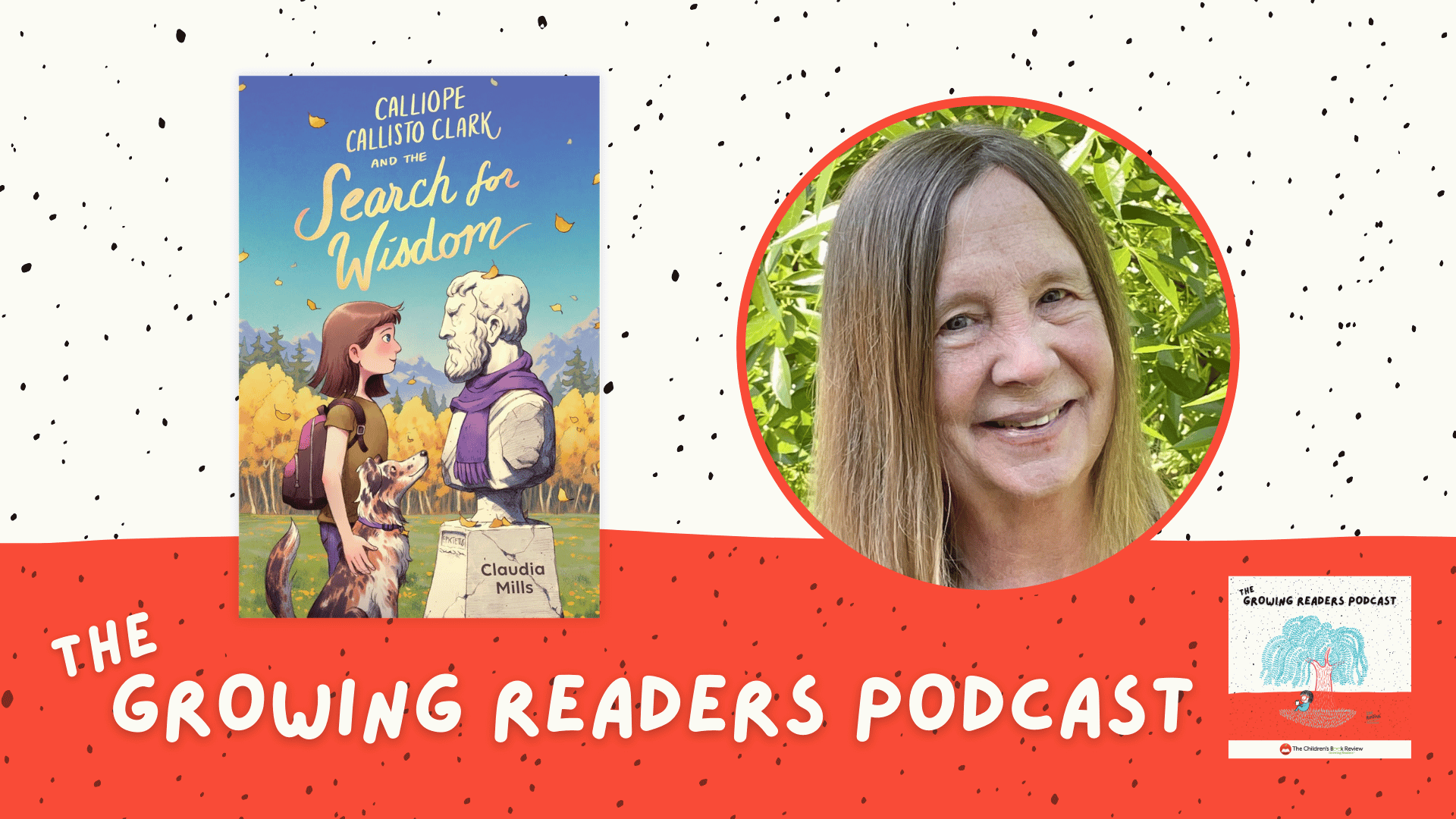
A podcast interview with Claudia Mills discussing Calliope Callisto Clark and the Search for Wisdom on The Growing Readers Podcast, a production of The Children’s Book Review.
Award-winning author Claudia Mills channels her decades of teaching philosophy into a heartfelt novel about a ‘disruptive’ student and the search for wisdom in impossible situations.
What happens when a girl with a very big name, a very big personality, and a very beloved dog turns to ancient Greek philosophy to save everything she loves? In this podcast episode, acclaimed children’s book author and retired philosophy professor Claudia Mills joins Bianca to talk about her hilarious, heartfelt new middle grade novel, Calliope Callisto Clark and the Search for Wisdom—and why Epictetus, Socrates, and Plato might be exactly what today’s young readers need.
Subscribe to The Growing Readers Podcast to ensure you never miss an episode celebrating the creators shaping young readers’ lives.
Listen to the Episode
The Show Notes
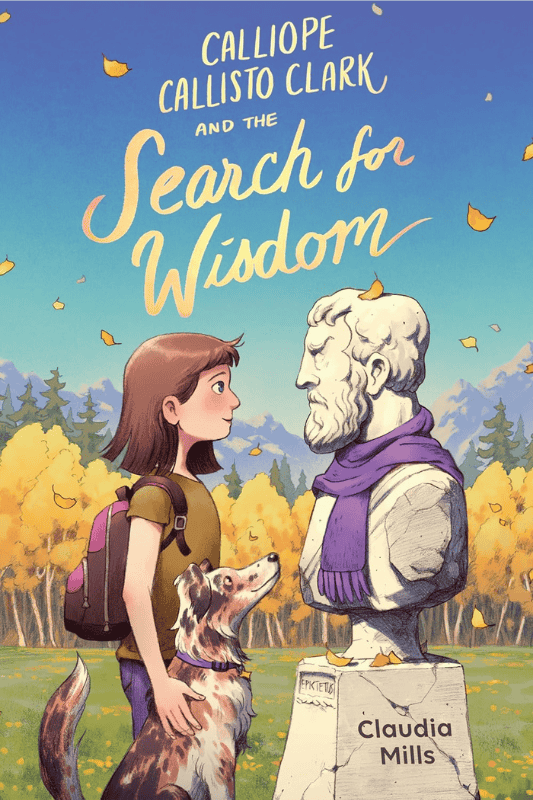
Publisher’s Book Summary: “Difficult” student Callie joins a philosophy club seeking the wisdom she needs to keep her beloved but equally difficult dog in this hilarious, heartfelt middle-grade novel for underdogs and dog-lovers alike!
Once Callie (Calliope Callisto Clark) starts saying something, it’s hard for her to stop. The opinion gets bigger and bigger, her voice gets louder and louder—and she gets in more and more trouble. She’s in trouble with her teacher, who likes order and not Callie. She’s in bigger trouble with her Grampy, who blames Callie and her dog (a.k.a. Best Ever Friend) Archie for his ever-rising blood pressure. Then there’s the biggest trouble of all… just one more strike, and Callie could lose her beloved Archie forever.
When she turns to Greek philosophy for answers on how to solve her problems, she only gets more questions: What is justice? What is fairness? And as her problems get bigger, so do her questions: Is it Callie’s fault when Grampy has a stroke?
Told in Callie’s endearing, energetic voice, Calliope Callisto Clark and the Search for Wisdom is sure to speak to any student who’s ever been called “disruptive.” Acclaimed children’s book author and retired philosophy professor Claudia Mills delivers a heartfelt middle-grade novel for misunderstood readers who feel like they’re living their own Greek tragedies.
A Junior Library Guild Gold Standard Selection
Buy the Book
About the Author
Claudia Mills has written over sixty books for children, including The Lost Language, an NCTE Notable Verse Novel, a Charlotte Huck Recommended Book, A Mighty Girl Best Book of the Year, and A Bulletin for the Center of Children’s Books Blue Ribbon Book. Her most recent book, The Last Apple Tree, received a starred review in Kirkus Reviews. She is a recipient of the Kerlan Award for her contribution to children’s literature. She was a professor of philosophy for more than two decades at the University of Colorado. She lives in Boulder, Colorado.
Visit her at claudiamillsauthor.com.

Credits:
Host: Bianca Schulze
Guest: Claudia Mills
Audio Editor: Kelly Rink
Producer: Bianca Schulze
Read the Transcript
Bianca Schulze: Hi, Claudia. Welcome to The Growing Readers Podcast.
Claudia Mills: Thank you so much for having me, Bianca.
Bianca Schulze: Oh my gosh, I am so thrilled to have you, because you’re just one of my favorite human beings in this wonderful little kid lit world that we live in.
Claudia Mills: Which has a lot of wonderful human beings, I must say.
Bianca Schulze: There really are a lot in this industry. I think we’re really, really lucky, especially when we take the time to stop and connect with one another. Well, I want to start with some fun rapid-fire questions, just to get the conversation going. Whatever pops into your mind — you can reserve the right to have a different answer another day. Socrates, Plato, or Epictetus: if you could have dinner with one, who’s getting the invite?
Claudia Mills: Epictetus.
Bianca Schulze: Hot take! Is it ever wise to break the rules?
Claudia Mills: See, that is much too complicated for a quick answer, as readers of the book will learn. What Callie learns in the book is that there are no simple answers in the world of philosophy. So I would be very wary of anyone who is too absolute with a quick answer.
Bianca Schulze: I love that response. Okay, finish this sentence: true wisdom is…
Claudia Mills: I think true wisdom is learning how to live well.
Bianca Schulze: You’re the best. Okay, and then last one: the one thing in your life you’ve learned you absolutely cannot control.
Claudia Mills: Well, it’s basically everything except myself, but in particular other people. And that is the most disappointing answer, because they’re what we want to control most, but absolutely cannot. And I need to remind myself of this every single day.
Bianca Schulze: Yeah, me too. And it comes up a lot in my household too — we talk about that a lot. Well, now we can go into some longer answers. This is my signature question that I love to ask every first-time guest: to be a writer, they say you need to be a reader first. So was there a pivotal moment in which you considered yourself a reader?
Claudia Mills: Well, I read fairly young. My mother made little flashcards to help me learn the hard words in books, and she was an elementary school teacher herself, so she put a premium on literacy. But she insisted that I read all my library books out loud to her — I think she wanted to make sure I wasn’t just holding the book and pretending I could read. It felt like years went by, but I don’t think it really was. But then when I was finally able to read in the privacy of my own head — just me connecting with the book and the characters in it — I felt like I had entered the world as an independent reader. I got my mother’s stamp of approval.
Bianca Schulze: Beautiful. So you’ve been a reader since childhood, and your mother had you read those library books aloud to her. Looking back, what do you think that practice of reading aloud gave you as a future writer?
Claudia Mills: Well, I think it gave me an ear for language. I pride myself on being a good — what I call — reader-alouder. I’m a good reader-alouder because I developed a fluency and expression that helped train my ear for language and for dialogue in particular as a writer. Because I had to hear my own voice all the time reading, it made reading an oral as well as a visual activity for me, and I think that benefited me as a writer.
Bianca Schulze: Yeah. Well, you’ve shared before that you write using your famous hour-a-day system, timed with an hourglass, and I love this. Can you walk us through how that system works and why you think it’s been so effective for you over so many decades?
Claudia Mills: Well, there are about 500,000 reasons why the hour-a-day system, timed with the hourglass, is optimal — at least for me, and it might be for a lot of your listeners as well. First of all, the most common thing people say is, “I would love to write a book, but I don’t have time.” And everyone gets the same 24 hours a day — the question is how we use them. It’s daunting to think of having to find that time, but if you only have to find an hour — and I actually have a backup half-hour hourglass for when I only have a half hour — it encourages you to seize that one hour. And if you only have one hour, you focus. That is your hour. That is the gift you have given yourself. That is the gift that the muses have given you. And so you use that hour. Now, that doesn’t mean you use it all the time scribbling across the page, but you use it knowing that this is your hour. And there’s something about the hourglass that enhances the sacred nature of the hour. You turn the hourglass over, the sand is sifting through, and you feel like you’re entering this enchanted space using this ancient tool — connecting with writers throughout antiquity and this long tradition before you.
Claudia Mills: I also really like the hourglass because I’m someone who, if I’m going to start writing at five in the morning and then it’s 5:03 — well, that blew five. I’ll start at six. But now it’s 6:02, and that ruined six. But when you have the hourglass, your hour begins whether it’s 5:17 or 5:19. Your hour is sort of outside of ordinary clock time. It is just the time that is given to you by the hourglass. Now, some people think my system involves writing for a minimum of an hour a day, but it’s also a maximum. I think there’s something about stopping when the sand flows through to the bottom of the glass, and then you have 23 hours to let your ideas slip into your subconscious and be worked on there. They say that after writers finish a draft of a book, they should step back and take some time off to get distance. Well, I give myself that gift every single day. And also, if I ever do break the rule and do two hours, the next day I don’t even want to do the one hour. It takes too much out of me. This system is just absolutely perfect, I declare.
Bianca Schulze: I love that. I never really thought about the importance of making sure that you stop. I feel like I need to put your practice into my own day. I love the idea behind the hourglass, because I am somebody who tends to block out my calendar in specific amounts of time — and you’re right, if I start at 5:07, I’m already shortchanging part of my hour. I never really thought about the hourglass. And I had a silly moment when you were describing it — my mom was a big fan of watching Days of Our Lives, so I immediately thought of, “Like sands through the hourglass…”
Claudia Mills: Yes, my mother was too, and I watched it with her! Yes — like sands through the hourglass, so are the days of our lives. And if I have to get up during the hour for some reason, I tip the hourglass to its side and then turn it back when I return. But I’m always afraid I’m tipping it the wrong way and getting confused, so I do my best to orient it correctly when I return to my task.
Bianca Schulze: I love that. Okay, now we’re all going to be out buying beautiful hourglasses.
Claudia Mills: Well, truly, after I give a presentation, hourglass sales are measurably increased around the world.
Bianca Schulze: I mean, I think we need to find some beautiful, crafty person on Etsy who makes the special Claudia Mills version.
Claudia Mills: Yes, she and I can go into business together.
Bianca Schulze: Exactly! Well, Claudia, what is it that drives you and guides you to write specifically for kids? What makes you get up out of bed each morning and choose to write for kids?
Claudia Mills: Well, I think it’s because of how profound that childhood reading experience was for me. The books I read as a child touched me in a way that no book has touched me since — I do love some books for grownups, I will acknowledge that. But those books I read as a child, because I was impressionable, because the world was new to me, they had this staying power with me. I still return to those books. I have a whole bookshelf full of my childhood favorites, and if I’m sad or I’ve had a disappointing day, I go get one of those books and get into bed with it, and it makes the day right again. So I think it’s the lasting power of those books that I want to be part of. And I also think they say that you have a certain age that you are inside. I think I’m ten years old inside. You look in the mirror and think, this does not look like a ten-year-old — but I’m ten years old inside, and I feel like I have a ten-year-old voice. Even when I write for adults, even in the academic things I write, I sometimes feel like it’s still my ten-year-old voice telling the story.
Bianca Schulze: Yeah. Well, you’ve written over 60 books for young readers — that’s phenomenal. And you’re also a professor emerita of philosophy. So how do those two worlds, children’s literature and philosophy, finally collide in this beautiful new book?
Claudia Mills: Well, it was a long journey, though I felt in a way from the start that there was a connection. I like to say that philosophers are the grownups who keep on asking the questions the other grownups have stopped asking — those “why” questions and “what’s it all about” questions, pressing for deeper and deeper understanding. I think that is very childlike and also very philosophical. So there’s a natural kinship there. But over the years, sometimes in my philosophy classes I would bring in children’s literature. When I taught Nietzsche, I would read to the students The Rainbow Fish, which was a book that Nietzsche would have hated — because Nietzsche was not about sharing and leveling and equality and sameness, not about taking one of your bright shiny scales and giving one to everybody. No, Nietzsche was about being on top of the mountain, solitary, unique. And so I would read my students The Rainbow Fish and say, “All right, now let’s talk about why Nietzsche would hate this book.” So I brought children’s literature in whenever I could. And I did bring philosophy into my children’s books, but obliquely. I never had my characters read a philosopher, but I had them asking ethical questions — and I never wanted them to be questions with easy answers. I wanted them to be questions with hard answers.
Claudia Mills: So in one of my books, I have a character who’s an aspiring author — who oddly enough has certain similarities with me — and she has a dilemma that I think almost every author has who draws on her own life. If I write about my own life, I’m going to write about the people in my own life, and those people are real human beings who have feelings, who may be hurt, who may feel exploited, who may be angry. How do you balance the need to respect their privacy with the need to tell your story, which is sometimes the only story we can tell? I gave that dilemma to my young character. She has a chance to publish something about her brother who taunted her and made fun of her writing — it’s finally her chance to show him how successful she is. But what she’s writing is deeply personal about him, and she has to wrestle with that choice. So I was bringing these two worlds together in small ways. But then I thought: I want to have one character actually encounter the words of a philosopher. Not a time-travel book where she gets to go back to ancient Greece, but actually encounter the words. Because I loved the ideas of philosophy, but I also loved the words. I sometimes think I fell in love with the words first — words like teleology and metaphysics. I just love these words and wanted to know what they meant and be able to drop them casually into conversation. And I wanted to let one of my characters meet the words of one of these philosophers. And so that’s what inspired me to bring my two lives together so directly in this book.
Bianca Schulze: Yeah, I love that. And I just want to say — I feel like you did such a beautiful job of doing exactly what you just described, but in such a fun, relatable way for kids. It doesn’t feel preachy or teachy or any of that. It just flows so delightfully, with these little nuggets of wisdom woven right in. Well done.
Claudia Mills: Thank you. I also wanted young readers to see that you can read these great works of philosophy — though I knew a sixth grader was probably not going to get very far on their own. That’s why I created the Philosophy Club in the book, where there could be an adult mediator to help present these ideas. You read these great works of philosophy, but you can disagree with them. In fact, you’re almost forced to disagree with them, because they disagree with each other. There’s no unanimity in the history of philosophy on any view. So you have the right to ask exactly the kind of question you asked at the beginning: is it ever acceptable to break a rule? And if you do, do you have to accept the punishment? Socrates’ friends argued with him about this, and he argued back with them. And Epictetus is my very, very favorite — but I have Callie and her fellow club members and her beloved librarian point out some aspects of Epictetus that they don’t agree with.
Bianca Schulze: Well, let’s talk about your main character, who has a very cool name. She insists on being called by her full name, which is Calliope Callisto Clark. I love that detail. So tell us about the significance and the particular reason you gave her such a grand, lyrical name.
Claudia Mills: Well, in literature and in the Bible and everywhere, names are significant. And the moment where you change your name is a significant moment. In the Bible, Saul, who persecuted Christians, becomes Paul when he becomes a Christian; Abram, after he makes his covenant with God, becomes Abraham. It’s an ancient way of signifying a deep and important change in identity. We see it when immigrants have come to America and been forced to change their names, and in the tradition of women taking their husband’s name — this deep change of identity that comes with that. And we all go through some version of it. My friends whose names were like Judy or Susie had to start spelling it with an “i,” or tried out other variants on their name just to make it their own. Names matter. I think I was drawn to the grandiosity of Callie’s name because she is someone who wants to be extraordinary, and using her full name is one way to do it. And she has her best friend Peggy, who is not at all like Callie — much more matter of fact and down to earth. Peggy is not a name you hear much nowadays, but in graduate school I had a friend named Peggy Nicholson, and another grad student and I decided her name was too plain because it wasn’t short for Margaret — it was just Peggy. And so we decided her name should be Pegasus Nicolopoulos. So I have Callie trying to rename Peggy too, and Peggy balking at it. I just liked that way of showing Callie’s character right from the beginning, and also showing that she was going to go through a major change in her life in the course of this book.
Bianca Schulze: Yeah. Well, Callie is a big personality. She erupts with opinions. She loves her dog fiercely. And she’s genuinely trying to become a better version of herself throughout the story. What drew you to writing a character like her?
Claudia Mills: Well, in a way all my characters are aspects of myself. But with Callie — I was a very, very intense child. Very, very intense. And I was probably this way until about 20 years ago, when I finally calmed down a little bit. So I identified with her strongly. But I also knew that since I wanted to introduce philosophy, I wanted a character who would really need the philosophy, who would really have a genuine hunger for this kind of wisdom. For Callie, the motivation is in some sense instrumental: her grandparents are going to take her dog away if she doesn’t shape up and get her dog to shape up. So she thinks, “I need all the wisdom I can get.” But I also wanted her, because the ideas themselves are intense and challenging for an eleven-year-old, to be someone who is ready for that because of her intellect, not just her emotional intensity. Her emotional intensity is why she kind of needs the toning down that comes from Stoicism, but her intellectual intensity is what makes her able to welcome these ideas.
Bianca Schulze: Yeah. Well, you mentioned the Philosophy Club just a moment ago, so let’s dig into that a little bit. The club at the heart of this story explores the works of Socrates, Plato, and Epictetus, and Epictetus in particular seems to be Callie’s guiding light. Tell listeners a little bit about who Epictetus was and why his ideas feel so relevant for an eleven-year-old living today.
Claudia Mills: Well, he’s my favorite philosopher — though on different days of the week I might have different favorites. His central message is that there are only two kinds of things in the world: things you can control, and things you can’t. Everything can be sorted into those two categories — things that are up to me, and things that are not up to me. And it’s such a liberating moment when you realize how little of the world you can really do anything about. Of course, this raises the question at the very end of the book: is this encouraging passivity? Is it just throwing up your hands and surrendering? But you can do a lot worse than accepting what can’t be changed. I just thought his wisdom was exactly what we all most need. I also had fun trying to identify bits of philosophy that would be accessible to young readers and get them wanting to talk.
Bianca Schulze: Yeah. And did it just make your philosophy professor heart so happy to come up with a story that had a Philosophy Club in it?
Claudia Mills: It did. It really did. And it feels especially timely, because nowadays the humanities are under attack. Philosophy departments, humanities departments at universities are being cut. I’m not going to knock the importance of STEM — science, technology, engineering, and math are important. And sometimes they’ll throw the arts in and make it STEAM. But what about the humanities? We need that H in there. The humanities are considered expendable, and I think they’re essential. So it was part of my hidden agenda, I think, to make young readers and adult readers think: wow, this is something worth learning. I wish I had learned this sooner. And I’m glad I got to learn it by reading this book.
Bianca Schulze: Yes! And I always think about reading itself as a fundamental skill behind all other kinds of learning. I’m going a little off-script with this question, but what do you think about philosophy as an underlying fundamental skill behind all of the others — like STEAM, for example? Maybe if you have a more philosophical mindset, maybe that allows you to be more open to experimenting within the sciences, and maybe you come up with a discovery because you’re able to think more philosophically. What are your thoughts on that?
Claudia Mills: I think that’s absolutely right. And it’s sort of strange that philosophy is for the most part not taught in K–12 education. There is a movement — Philosophy for Children, or P4C — that is trying to correct this. But they don’t do it generally by bringing in the great philosophers; they do it by getting children to talk philosophically among themselves, posing a question like “Is it ever right to break a rule?” and letting the children come up with all the arguments and counterarguments. I have a weakness for the texts and the great books and the words — but the movement exists because philosophers claim, and I think rightly, that we are the best there is at teaching critical thinking. Critical thinking is logic. Who invented logic? Aristotle. He was one of the first to codify logical principles. So we own critical thinking. It is a skill that’s going to be helpful in whatever field you enter. But I have to say — I gave our department’s little commencement address when I retired, and I said yes, we’re the best at critical thinking, but I also wanted to teach what I’d call appreciative thinking: that there are just these wonderful ideas, this wealth of beautiful things made by novelists and historians and philosophers who are trying to understand the world. Just to marvel at the richness of what the human mind can generate — and to stimulate your own brain to generate.
Bianca Schulze: Yes. I’m all here for it. I like your acronym — STEMF. It’s like putting the oomph into STEAM, just because you’re a genius. Well, there’s a quote in the book: “Wisdom belongs to everybody.” And that feels like the heart of the story. Talk to me about that quote and how it fits with Callie’s tale.
Claudia Mills: That just popped into my head on the spot during this interview, I should say! But I want to say one thing first. At the university, I noticed that some departments were eager to weed out majors. Chemistry would make organic chemistry so hard that they hoped a lot of people would fail, because they were pre-screening for medical school. In philosophy, we never felt that way. We thought everyone should major in philosophy or at least get exposed to philosophy, and we rejoiced any time anyone came into the fold because we truly thought philosophy belonged to everybody and that everybody needed it. And I think the way it fits into this story is through the Philosophy Club. The club starts very small — basically just Callie and the school librarian. Her friend Peggy doesn’t even want to do it at first. She says, “You really want me to read boring books by boring old dead people and just die of boringness?” And Callie says yes, but it isn’t going to be boring. And Peggy is sort of won over by these ideas. And Callie’s nemesis, Philip Kumar, who she thinks is such a know-it-all and teacher’s pet — he’s naturally drawn to these ideas, but she’s not naturally drawn to having Philip in the club. But then she finds that through their interactions there, it becomes a new way for them to connect. And then — spoiler alert — there’s a surprise addition to the club at the end. The person Callie would have felt was least likely to join the search for wisdom.
Claudia Mills: My favorite review of the book was from Kirkus, who said that the book is a love letter to seekers. And I think that’s exactly what it is and what I wanted it to be. There’s a camaraderie among seekers — we’re all seekers together. Seekers don’t always find, and seekers can be mistaken about what they find. But the community of seekers is a very powerful form of community. And I think the more we all thought of ourselves as seekers rather than as people already certain about every single thing we believe, the better the world would be.
Bianca Schulze: Yes, I love that. Seekers. In my mind, I always think of curiosity as what makes you a seeker. I think sometimes — and maybe this is what Peggy was feeling — ancient philosophy can feel intimidating from the outside, even for adults, let alone middle schoolers. So talk to me about how you wove those big ideas into the story so naturally that it never feels like a lesson.
Claudia Mills: Well, I tried to pick accessible, detachable bits of philosophy so I didn’t have to engage with someone’s whole huge system. I was very intrigued by the story that Plato puts forward in The Republic of the Ring of Gyges — this ring that a shepherd finds. He puts it on his finger and becomes invisible, and now that he’s invisible, he can sleep with the queen and murder the king and take over the kingdom. And the question: what would you do if you were invisible? I thought that’s something kids would really get engaged in talking about. And then Socrates’s realization that he’s the wisest of all men simply because he alone knows he knows nothing — that’s pretty good to ponder. And then his being sentenced to death by the people of Athens for stirring up curiosity and questioning among the youth of the city, condemned to drink hemlock — and he’s willing to go ahead and do it because he thinks it’s important to obey the law, while his friends are saying, “Are you out of your mind? Escape! We can save you.” I thought these would be fun things for kids to talk about. And then it just seemed as if almost organically, these ideas wove themselves into Callie’s life — because Callie is so full of herself and her troubles that she relates everything back to herself. I almost didn’t have to do it for her. She lets her dog off the leash and thinks the police are out to arrest her, which isn’t true, but then she gets to ponder: should she accept the punishment for having an off-leash dog? Well, no — she’s planning to run as fast as she can. So she would bring these ideas back to herself in a natural kind of way. Peggy does less of that, but Philip, in a couple of scenes, brings it back to himself too. Peggy is more quiet, doodling, and then saying some really smart thing — because she is. There’s a lot more to Peggy than meets the eye.
Bianca Schulze: Yeah. Well, I want to talk a little more about what Callie has going on. Some of it is alluded to in the backstory, but she’s navigating some genuinely heavy circumstances — she’s an orphan, she’s at risk of losing her dog, and then her Grampy has a stroke. So you also had to balance that emotional weight. And I think you balanced it with what I’d call a really charming level of humor that runs throughout the book. Was it an intentional effort to find that balance between the emotional weight and the lightheartedness? Or does that come naturally for you when you’re writing?
Claudia Mills: Well, this particular book is unusual for me — I don’t usually write in first person. I like to write in third person. But with this book, I started writing just letting Callie talk to me and pour out her feelings about her name and her family and her situation. And I liked her voice so much that it allowed me to continue. I think some of the children’s books of the past subconsciously influenced me — like Anne of Green Gables. Anne has a terribly difficult life — orphaned, with really cruel foster families — but she’s always looking for the joy in every situation, finding what she calls scope for imagination in her circumstances. So maybe subconsciously Anne was a little bit of a role model for Callie. And Anne also truly has those very intense highs and lows — soaring with rapture and then in the depths of despair.
Bianca Schulze: Yeah. Well, you have such a rich backlist, including The Lost Language and The Last Apple Tree and your After-School Superstars chapter book series, and I could keep going. So for listeners who are just now discovering you through Callie, where would you want to send them next?
Claudia Mills: Well, I write mainly middle grade and then third-grade-level chapter books. The age of a reader who loves Callie might not be drawn to the third-grade-level stories — it’s more that the third-grade-level reader might grow into Callie’s story. But I think The Lost Language and The Last Apple Tree, the two other middle grades I’ve done recently, both have big questions that might appeal to those drawn to the kind of questions Callie is considering. The Last Apple Tree looks at family secrets — how their very secrecy can be toxic within families, and how exposure can feel scary and painful but also liberating. And in The Lost Language, I bring in the whole issue of endangered languages and expose readers to that as a real tragedy in the world. But it also raises the question: why is it a tragedy? Things change all the time. Look at the English language, how it has changed enormously since the time of Chaucer — do we think that’s terrible? So to think about languages, and also to think about how we use language in our own lives. My main character in that book, Betsy, is the quiet one. Her friend Lizard is the force to be reckoned with — she’s the Callie. Betsy has a best friend who’s a Callie, and she’s more the introspective, introverted one, but gets to come into her own. I think there’s a lot of rich material for thought in those other books.
Bianca Schulze: Yeah. Well, we’re getting towards the end of our conversation, and I’m going to put you on the spot. Do you have a copy of Calliope Callisto Clark and the Search for Wisdom near you?
Claudia Mills: It just so happens that I do.
Bianca Schulze: Do you have a highlight — a little piece that you would be willing to read out loud?
Claudia Mills: Okay. I think I like the scene near the beginning that sets up Callie’s need for philosophy — this thing that has gone very wrong with her grandparents. She’s had an altercation with her teacher at school, a message has been called in to her grandparents’ home. She gets home to find no one there and starts to worry. Then she hears the garage door opening. And this may be a couple of pages, so you can cut me off when you think it’s enough. She goes out to the garage:
Grampy was helping Granny out of the car — and he is not a chivalrous ladies-first sort of gentleman. Granny had her arm held stiffly in front of her, all wrapped up in what looked like big bulky bandages and carried in a sling.
Granny, what happened? No, Archie — I’ve told you over and over again, no jumping. Archie, stop it. Archie, get down. Grampy let loose a string of very bad words. Unless my eyes were deceiving me, he gave Archie a kick, and my grandfather is not a violent man. Nobody answered my “what happened?” question until we were all in the house and Grampy had settled Granny in her chair and I had put Archie in the downstairs bathroom, which was our equivalent of dog jail — or maybe, the way things were going, maximum-security dog prison, because I was getting a bad feeling that whatever had happened to Granny’s arm might have something to do with Archie.
“What happened,” Grampy said then, emphasizing his words. “What happened,” he repeated, “was that your grandmother was getting ready to take your dog on a short walk so that your dog would burn off some energy and stop trying to dig a hole to China in the middle of her favorite braided rug. When the phone rang and the answering machine picked up, we could hear it was a long message from your teacher. So Granny hurried to the phone, leash still in hand, but your teacher hung up before she reached it, and your dog got himself tangled up in the leash — as his mission is always to be maximally in the way. And she tripped and fell and broke her wrist, which may or may not need surgery and will likely take four to six weeks to heal.”
I thought Granny might say, “No, Henry. Let’s not make this sound worse than it is. You’ve made it sound like this was Callie’s and Archie’s fault.” But she didn’t.
“Callie,” Grampy said, “when we let you adopt Archie from the Humane Society back at the start of August, it was an experiment. It was Granny’s idea, not mine, but I was willing to give it a try. ‘Maybe a pet would be good for Callie,’ your grandmother said. ‘Maybe now that she has the challenge of starting middle school, it would have a calming effect on her. Maybe it would even out her moods.’” My bad feeling was getting worse, like 10,000 times worse.
“It has helped,” I said, though this was the first time I had heard anything about an experiment. An experiment involving me. An experiment involving me as a guinea pig or lab rat or some other creature at the mercy of cold-hearted scientists. “It has been good for me. It’s been wonderful for me. I am calmer. I try to keep my voice calm right now. My moods are all happiness when I’m with Archie. I don’t get super upset about things anymore. I haven’t gotten super upset about anything since—”
“This morning,” Grampy said. “Since, according to your teacher’s voicemail message, you apparently threw a fit, or had a tantrum, or a meltdown, or whatever one calls these things. Callie,” he said again, and the sorrowfulness in his voice was downright terrifying now. “The experiment didn’t work. It hasn’t helped you, and it hurt your grandmother. It takes a long time for old bones to heal.”
Don’t let him say it. Don’t let him say it. Don’t let him say it.
I turned pleading eyes to Granny, but her eyes were as full of tears as mine were starting to be. “Honey,” she said, “Grampy is right this time. We’re going to have to let the Humane Society find a new home for Archie. A good home, a loving home.”
“No. If you do that, you will break Archie’s heart, you will break my heart, and broken hearts like broken bones never heal.”
A moment later, I had locked myself into the dog-prison bathroom with Archie, holding him tight as he licked my tears with his long loving tongue. Now Grampy and Granny would see what a real meltdown looked like — one that would last till the end of their lives and the end of mine.
Bianca Schulze: That was so wonderful. I’m like, I’m ready for you to just keep reading! So Claudia, I have to ask you: what’s the one thing you hope listeners carry with them from our conversation today? Just one tiny nugget of wisdom that helps them take one tiny step forward in their lives.
Claudia Mills: Well, it will have to be this: there are things you can control and there are things you can’t. And all you can really do something about are the things within your control. You can’t control other people. You can only control yourself — your feelings, your impressions of things, because according to Epictetus, how you see the world, your perspective, is the source of everything. You can control your choices and your actions. And that is it. But I’m also hoping that the grownups in charge of education say: the humanities are important, and the humanities are good. And let’s give them the attention they deserve in our schools.
Bianca Schulze: Yes, absolutely. And if we have teachers and educators listening, Claudia has put together an amazing discussion guide that I think is so great for pairing with Callie’s story — you could have your own little mini Philosophy Club just based on that guide. Claudia, on behalf of every Growing Readers listener today and every kid who has ever felt too big for the room, or too loud, or too full of opinions — I relate — just thank you. Thank you for writing Calliope Callisto Clark and the Search for Wisdom, for bringing Epictetus to middle grade, and for reminding all of us that wisdom really does belong to everyone. And thank you for the 60-plus books, for your hour-a-day dedication, and for continuing to show up for young readers. We’re so lucky to have you in this community, and it’s been such a joy to have you on the show today.
Claudia Mills: Well, thank you for having me, and thank you for all you do to bring books to readers and bring readers to books, and to foster just this kind of community of seekers that we’ve talked about today.
*Disclosure: Please note that this post may contain affiliate links that share some commission. Rest assured that these will not affect the cost of any products and services promoted here. Our team always provides their authentic opinion in all content published on this site.